
China’s Open-Source Strategy and Its Global Implications
As AI ecosystems diverge, navigating between open and proprietary models is becoming critical in the AI strategy

If you want to understand the future of global AI, you need to look beyond Silicon Valley. China has become an equally important center of AI innovation and experimentation.
Here, a radical transformation is unfolding. While Western giants like OpenAI and Anthropic are building proprietary ecosystems around their most powerful models, China is taking a different path. Its leading tech firms, like Alibaba and DeepSeek, are making a huge bet on open source, releasing state-of-the-art AI open-source models for the world to use and build upon.
It’s a different philosophy. And it’s a direct challenge to the Western trend toward proprietary AI models. So, why is China choosing this path, and what does it mean for the global tech landscape? Let’s unpack it.
Why China is betting on open-source
China’s open-source push rests on three pillars: sovereignty, speed, and global influence.
The first and most urgent driver is technological sovereignty. Western models from companies like OpenAI are unavailable in China, creating a vacuum that domestic providers are eager to fill. Facing strict chip restrictions and a need for technological independence, China sees open models as a strategic necessity. Competing with the U.S. head-to-head using the same closed-loop approach would likely be a losing game because U.S. holds the upper hand in capital, talent, and AI infrastructure. Instead, by fostering a vibrant open-source ecosystem, China is playing to its strengths: fast iteration, rapid scaling, and open collaboration. It allows China to build a self-reliant AI ecosystem to reduce the dependence on the West tech stack.
Second, it’s about speed and scale. Open-source models are refined by a global community of developers, researchers, and startups. This accelerates innovation, debugging, and adoption at a pace that no single corporate R&D department can match. It’s a way for Chinese companies to rapidly catch up and even leapfrog Western counterparts by leveraging the world’s brainpower.
Third, it’s about shaping the global landscape. In July 2025, China released its Global AI Governance Action Plan, a blueprint that explicitly calls for building “cross-border open-source communities,” facilitating “the open sharing of basic resources,” and lowering “the thresholds of technological innovation”. So China is aiming to maximize its global influence in AI by offering a powerful alternative to Western-led models.
How China’s best stack up against GPT-5
Grand strategy is nothing without efficient execution. So, how good are these Chinese models, really?
Let’s put the three titans in the ring: Alibaba’s Qwen3-Max, DeepSeek R1, and OpenAI’s GPT-5.
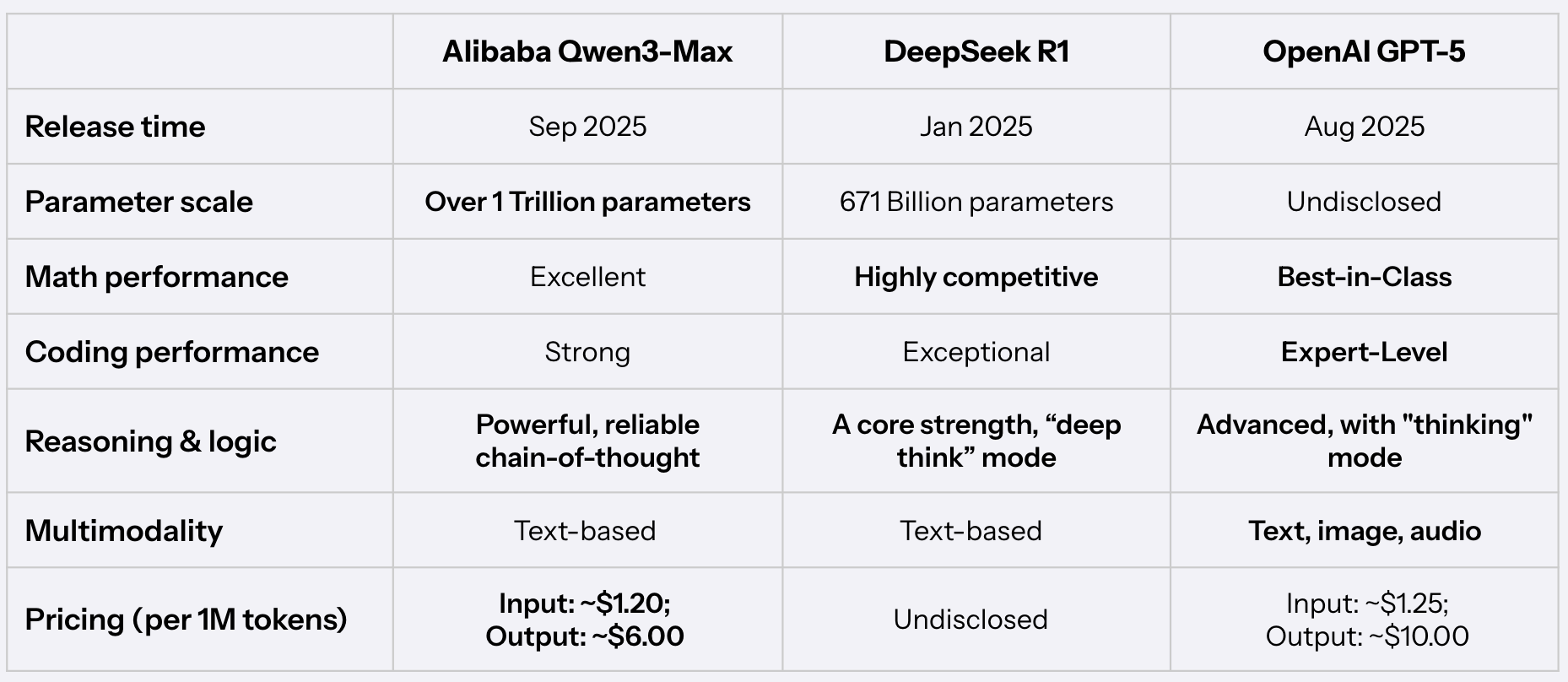
Now, let’s look at what these specifications mean in practice.
Alibaba’s Qwen3-Max is built for large-scale enterprise use. Its primary strength is delivering robust, high-performance results for complex tasks like coding and data processing, all at a highly competitive price point. This makes it a practical choice for businesses looking to integrate powerful AI without high costs. The main limitation of the current version is that it is a text-only model; it does not support image or audio inputs, unlike GPT-5.
DeepSeek’s R1 stands out for its exceptional performance in logical reasoning and mathematics. As a fully open-source model, it provides free access to capabilities that rival many closed, proprietary systems, making it a powerful tool for research and applications where cost is a major factor. However, because its development focused intensely on reasoning, its performance on specialized coding benchmarks, while strong, is not the best in its class.
OpenAI’s GPT-5 is distinguished by its native ability to understand and process both text and images. This multimodal foundation, combined with a sophisticated “thinking” mode for complex problems, makes it a highly versatile and reliable choice for a wide range of applications. The primary trade-off for this advanced capability is the cost, as it is typically the most expensive model to access via API, which can limit experimentation and large-scale use.
The global adoption of Chinese open-source models so far
The adoption of Chinese open-source models like Qwen and DeepSeek is accelerating fast. Qwen alone has surpassed 300 million downloads, with over 100,000 derivative models built on Hugging Face, making it one of the most widely adopted open-source AI families in the world.
Within China, adoption is booming, driven by the national strategy and the absence of Western competitors. These open-source models are being integrated into everything from industrial manufacturing and healthcare to the “AI Plus” initiative, which targets a 90% penetration rate of AI terminals and agents by 2029.
The more fascinating story is happening outside of China, where adoption is growing rapidly but uneven.
In the EU and UK, there is a strong sense of pragmatic openness, particularly among startups and specialized AI companies. It’s reported that many startups are experimenting with DeepSeek and Qwen due to their exceptional performance and cost advantages. A notable example is ElevenLabs, the leading synthetic voice AI startup, which announced a direct integration of DeepSeek-R1 into its core generative voice products, publicly citing its performance and cost benefits compared to Western models.
In the U.S., there’s huge curiosity around Chinese AI models, but also growing political tension. US developers and researchers are fully aware of the technical merits of Chinese models. A Reddit post titled “Chinese Open-Source AI Models Sweeping Through US Startups” recently went viral. As The Economist reports, Martin Casado, a partner at Andreessen Horowitz, noted that up to 80% of U.S. AI startups now use Chinese open-source models instead of those from OpenAI or Anthropic when pitching to investors. However, politics often gets in the way. Chinese models are often perceived as “security threats,” with some US senators even calling for investigations, which heavily influences enterprise procurement decisions.
Throughout Asia outside of China, the adoption trends are less publicly documented but strategically significant. The drivers in these regions are likely a mix of geographic proximity, economic collaboration, and shared digital development goals, as reflected in China’s AI Action Plan that emphasizes supporting the “Global South” in accessing AI technologies.
The road ahead is not easy
Despite the rapid progress, significant hurdles remain, particularly for the global expansion of Chinese open-source models.
The first challenge is the hardware dependency. The most advanced semiconductors required for training frontier AI models are designed in the U.S. and face export controls. This creates a potential long-term bottleneck for Chinese companies trying to keep pace with the next generation of AI.
The second, and perhaps more difficult challenge, is the trust and regulatory gap. There are always questions like: Where does our data go? Can we have long-term reliable access? Does the model have built-in biases? These aren’t just technical questions; they’re about fundamental trust, and it’s a barrier that code alone can’t fix. So for the western companies, especially in regulated industries, using Chinese AI models raises serious concerns about data privacy, compliance with laws like GDPR, and the long-term geopolitical risk of relying on a technology stack that could be affected by international tensions.
Finally, there is the ecosystem maturity gap. While the Chinese models are powerful, the surrounding infrastructure of developer tools, enterprise integrations, and third-party applications is not as mature as the ecosystems built around Western models like GPT-5. Widespread adoption requires more than just a good model; it requires a complete and reliable toolkit that businesses can easily plug into.
What does it mean for global companies
The global companies can’t simply pick one winner. Instead, they should find the right balance to navigate both ecosystems.
On one end, Western models often lead in raw research power and polished, out-of-the-box capabilities, particularly in complex coding and reasoning. On the other, Chinese open-source models offer a compelling value proposition: significant cost savings, greater customization, and a level of transparency that allows for deeper control.
This divergence is giving rise to a hybrid approach. In practice, it means combining the research depth and reliability of Western models for customer-facing products with the cost-efficiency and agility of Chinese models for internal research, and specific backend tasks. A company could also fine-tune a model like DeepSeek or Qwen on its proprietary data to create a specialized solution. ElevenLabs has demonstrated the potential, leveraging DeepSeek R1’s cognitive power while their own technology delivers the final user experience.
However, this approach isn’t plug-and-play. Companies integrating this model must proceed with caution, governed by clear principles:
Deeply understand the regulatory environment. This isn’t just about your home country’s rules but about the complex cross-border data laws and AI-specific legislation.
Prioritize data sovereignty. Ensure sensitive data remains under trusted, local jurisdictions.
Continuously monitor the policy landscape. Export controls and data transfer rules are moving targets.
The bottom line
China has built a parallel AI stack that operates differently, evolves fast, and serves different needs. Its open-source approach is a deliberate, long-term strategy offering the world a powerful alternative.
So, the question is no longer if global companies should use these models, but how they can do so securely and strategically.
This isn’t about choosing sides. It’s about preparing for a multipolar AI world.
The winners will be those who can combine the strengths of both ecosystems, balancing performance, cost, and compliance, while managing the geopolitical and operational risks that come with it.
Now is the time to experiment, partner, and integrate.